This systematic review and network meta-analysis investigated whether different vitamins, nutrients and dietary supplements can affect recovery and inflammation in adults with COVID-19. The researchers compiled 45 randomized controlled trials from 18 countries with a total of 3,793 patients.
The results show that some supplements can affect individual markers of inflammation. Vitamin C together with standard treatment reduced the inflammatory marker IL-6, while nanocurcumin increased the number of lymphocytes. Pomegranate juice also affected the ratio between neutrophils and lymphocytes, but the results were more uncertain and partly contradictory.
Most importantly, however, the researchers did not see any definite improvement in several clinically important outcomes. The dietary supplements did not reduce mortality and had no clear effect on, among other things, CRP, white blood cell count, neutrophils, fever, headache, cough or shortness of breath compared with standard treatment.
The researchers also emphasize that the results must be interpreted with caution. For several comparisons, the number of patients was small, a large part of the results were based on indirect comparisons and the evidence was often assessed as low or very low. Of the 45 included studies, 13 had a high risk of bias and a further eight had some methodological issues. The researchers themselves point out that the very large estimated reduction in IL-6 with vitamin C is likely unstable and should not be considered a reliable measure of treatment effect. The conclusion is therefore not that vitamins or dietary supplements can replace standard Covid treatment. Rather, the study shows that certain supplements can possibly affect specific laboratory values and therefore may be interesting as complementary treatment in certain situations. However, there is not yet strong enough evidence to say that they improve the most important clinical outcomes, and larger and better randomized studies are needed.
Text translated from Swedish, originally written by Patrik Andersson and published in Facebook group SARS-CoV-2 Omvärldsbevakning
Category: Protection
A large randomized trial investigated whether vitamin D3 supplementation can improve the course of COVID-19. The study included 1,747 people who had recently been diagnosed with COVID-19 and their household contacts. Participants were given either high doses of vitamin D3 for one month or a placebo.
The results showed that vitamin D did not reduce how often patients needed healthcare, such as hospital visits, emergency room visits or doctor visits. It also did not reduce the severity of symptoms, and it did not affect the risk of family members in the same household becoming infected.
However, the researchers saw a slight trend towards fewer persistent symptoms after two months in those who received vitamin D. Around 21% in the vitamin D group reported long-term symptoms compared to 25% in the placebo group. However, the difference was small and not statistically significant.
The researchers therefore believe that vitamin D is unlikely to reduce acute illness or the need for care in COVID-19, but that it may be worth studying further whether vitamin D can affect the risk of long-term symptoms after infection. No safety concerns with the treatment were reported.
Credit: Patrik Andersson
Categories
Adults Alzheimers Blood clots Brain damage Breathing protection Cardiovascular conditions Children DNA Genetics Heart disease Heart lesions Hospital Hospitalisation Immune dysfunction Immune system Long Covid Long Covid Lungs V/Q children Masks Mental health Micro Clots Nasal sprays as Covid-19 protection Neurological Damage Omicron Organ impairment Pregnancy & Covid-19 Protection PubMed Research Respiratory Resulting illnesses Schools Severe Covid Similarities with other viruses Study Symptoms The Virus Transmission Transmission and mitigation Trombosis Vascular damage and desease
What SARS-CoV-2 Does to the Body (2nd Edition, July 2023)
An extensive compilation of links to studies and statistics on what SARS-Cov-2 does to your body, brain etc. And it is way worse than most people know.
https://www.panaccindex.info/p/what-sars-cov-2-does-to-the-body

Categories
Adults Air cleaners Antibodies BA.4/BA.5 bivalent mRNA vaccines Break through infection Breathing protection CD14+ monocytes - White blood cells Children Exhausted T-cells Immune system Long Covid mRNA Vaccines Other respiratory viruses Other viruses Protection T-cells The Virus Traditional vaccines Transmission Transmission and mitigation Vaccines
COVID-19’s impact on the immune system, and how this may affect subsequent infections
Covid-19 opens up your immune defense for further infections.
Nasal spray vs Covid-19? Yes, this is a preprint of a study of a broad-spectrum antibody against COVID-19 as a nasal spray. The result is protection of above 70%. Read more via the link below.
To anyone at least little read up on the matter, the news that universal masking lessens the number of infected students and staff in schools comes as no surprise, as fewer viruses in the air means less risk for infections. Now there is even more proof.
It sort of says itself: if you put a filter in the stream of air entering your mouth and nose, you get fewer “things” entering your respiratory system. And respirators are very good at catching viruses.
It is kind of obvious that mask should make a difference. especially if we are talking respirator masks (N95/Ffp2/Kn95 etc) that are designed to protect the bearer from patogens like viruses. What we have sort of lacked is a real world comparison between a larger number of schools that keeps mask requirements and schools that remove mask requirements. And the result is clear: it makes a big difference. The first link is to the Time article about the NEJM published study.
https://time.com/6231516/universal-masking-in-school-works-new-data-shows-how-well/
https://www.nejm.org/doi/full/10.1056/NEJMoa2211029?query=featured_home
Air-Cleaners & Ventilation Matters!
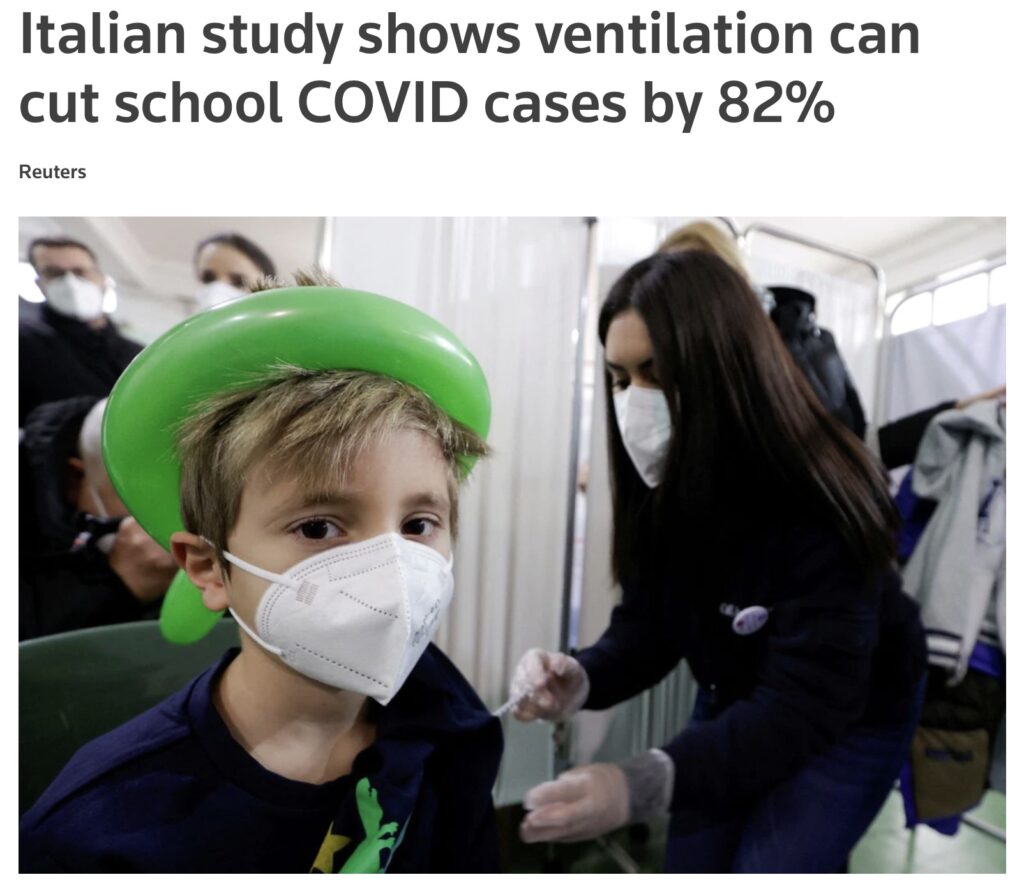
This important study shows the importance of excellent ventilation! This pretty much confirms the results of a number of smaller studies including those with Corsi – Rosenthal boxes.
This is of course applicable to offices and other indoor settings as well. Ideal is of course to improve ventilation, but air-cleaners can be a viable solution as long as you get the air filtered at least 6x per hour, as shown in other studies (link coming soon).
Combining the air cleaners with FFP2/N95/KN95 masks would likely stop spread of the virus in the setting pretty much 100%. Even with super-spreading variants of Omicron BA.5 and later dominating.
This overturns all the desinformation from big players like the Swedish Public Health Authority Folkhälsomyndigheten and Koch sponsored desinformation machine Brownstone Institute.
First the link to the Reuters article, second lik is to the study itself.
Brian Vastag is a former science reporter for The Washington Post. He here writes about the similarities between Long Covid and ME/CFS. And how Long Covid could have been prevented.
https://www.medscape.com/viewarticle/980876?src=wnl_tp10n_221013_mscpedit&uac=426586ET&impID=4742695